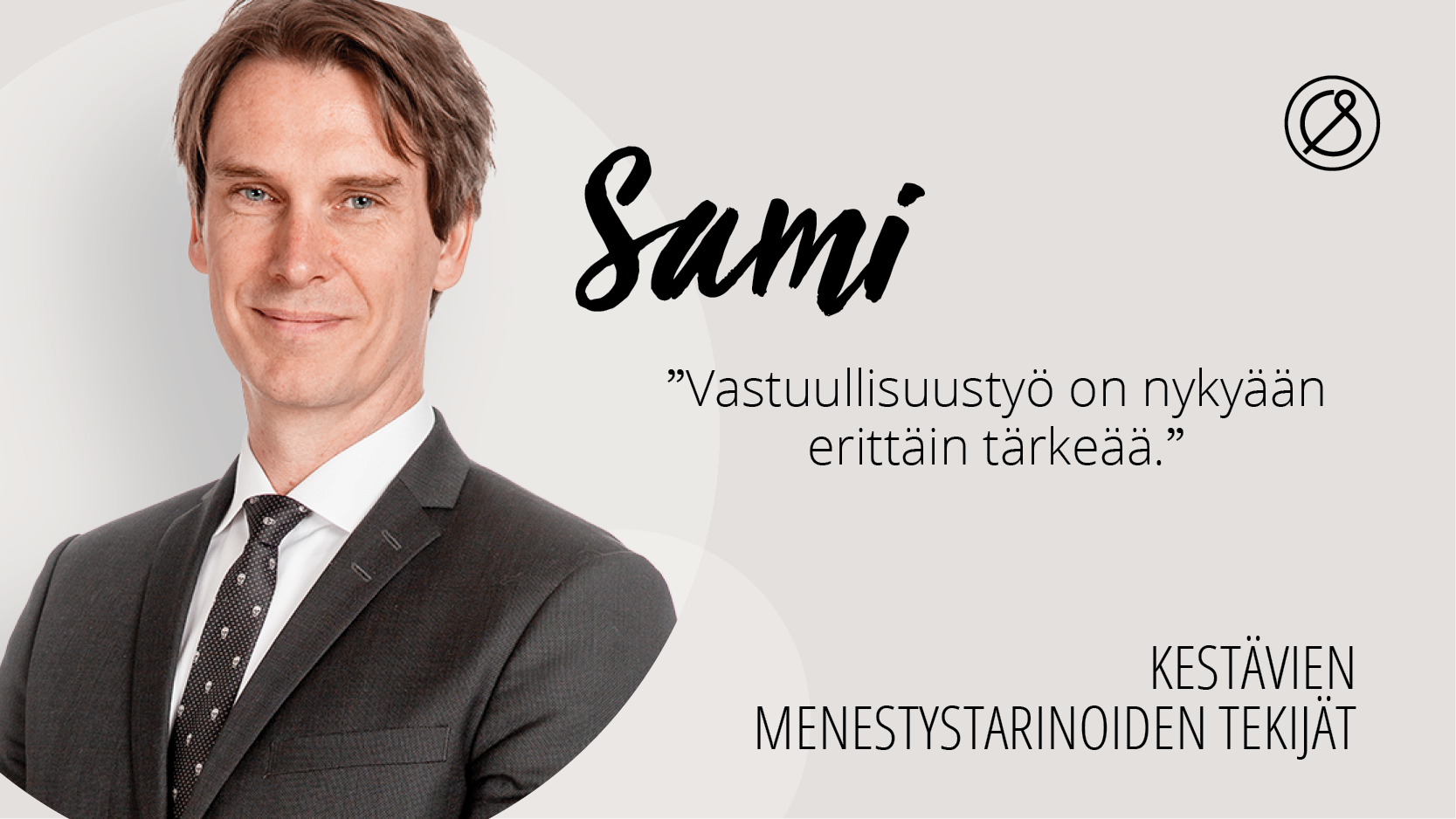

Many lawyers start working in a law firm while still studying and continue in that career after graduating.
Counsel Sami Lommi took a different path. Before joining Castrén & Snellman, he spent about fifteen years working in an insurance company in various legal positions, such as compliance officer, director of legal affairs and internal services and member of the management team.
What got him to buy services from Castrén & Snellman in his previous in-house career?
‘As a client, I was attracted to the firm’s skill capital and reputation for sustainability. Those were the main things that led me to choose C&S as a service provider.’
‘Sustainability, interpreted broadly, is vital today. No matter how good the skill capital of a company is, it is hard to justify buying services from that company if it does not take sustainability into account. It is well worth being ahead of the pack in this matter.’
Legal Degrees from Two Countries
Sami was originally supposed to be a dentist.
‘I fell off my bike and knocked my teeth out when I was ten. This meant that I spent a lot of my youth at the dentist’s office, and I became interested in the profession.’
‘In high school, however, I realised that I was not passionate about math and could retain text much better than numbers. I also became interested in societal matters. The high school I went to had an optional law course, which is what got me interested in the law.’
After high school, Sami studied in Sweden. Swedish is his native language, and he wanted to see a bit of the world. After graduating in Sweden, Sami moved back to Finland and got a second legal degree at the University of Helsinki.
A Financial and Insurance Regulation Expert
Sami joined Castrén & Snellman in 2019 bringing impressive insurance regulatory expertise to the firm.
‘I’ve spent a large part of my career working with financial regulation, particularly insurance regulation. My employers have included a Finnish banking concern and an international insurance concern. I have experience not only of regulation specific to the financial industry, but also relating to the prevention of money laundering, strategic planning and business development.’
At Castrén & Snellman, Sami has advised domestic and international regulated parties in a wide range of matters relating to the financial industry, such as arrangements, transfers of insurance portfolios, authorisations, governance systems, capitalisation, as well as the distribution and marketing of products. He has also advised clients in matters relating to anti-money laundering and sanctions regulations, has drafted and reviewed related guidelines and provided training on these matters both inside the firm and to clients.
‘I have enjoyed working here so much. A big part of wellbeing at work depends on how your supervisor acts, what the team is like, what kind of assignments you get to work on and how much control you have over your own work. I feel like all of those things are well balanced here.’
Towards a More Sustainable Legal Services Industry
In February 2021, Sami started work as Castrén & Snellman’s compliance officer alongside his client work. In this position, he supports the firm’s management and employees in acting sustainably and in compliance with legal services industry regulations.
Law firms are not required to have a compliance officer,but considering the importance C&S places on sustainability, the firm wants to ensure its risk management is second to none.
‘Compliance and risk management were already well in hand at C&S. I feel a bit like Toto Wolff in that I am stepping into a team that is already doing an excellent job. My goal is to use my experience to further refine the team’s work’, Sami says.
Latest news
Latest references

Banyan Software – Acquisition of Carus Ferry
We acted as legal adviser to Banyan Software on its acquisition of Carus Ferry, a Finland-based provider of reservation, check-in and port operations software for ferry and passenger shipping operators. The acquisition further strengthens Banyan Software’s presence in the Nordic region while providing Carus with a long-term partner to support its continued growth and development. Carus was founded in 1998 and is headquartered in Mariehamn on the Åland Islands, Finland. The company develops mission-critical software for ferry, cruise and passenger shipping operators, covering the full passenger journey from booking and ticketing to capacity management, check-in and boarding. Carus also provides port automation, onboard sales systems and business information tools. The company serves approximately 30 operators across four continents and is the largest vendor by customer count in ferry reservation and departure control. Banyan Software is an acquirer and long-term operator of mission-critical software businesses serving specialised industries. Founded in 2016, Banyan follows a buy-and-hold-for-life approach and supports the long-term growth and development of its portfolio companies. Banyan operates more than 130 portfolio companies across North and South America, the United Kingdom, Europe and APAC. Following the acquisition of Carus, Banyan operates three businesses in the Nordic region.
Case published 20.10.2026

Move Energy – Combination of 3North Partners and Steady Energy and related private placement and IPO
We advised Move Energy as an investor in connection with the combination of 3North Partners Plc and Steady Energy Oy and the related private placement and initial public offering of the combined company on Nasdaq First North Growth Market Finland. In connection with the transaction, 3North Partners received approximately EUR 69.8 million in investor commitments from a group of institutional and other investors, including Move Energy, to fund the combined company. Steady Energy is a Finnish nuclear technology company developing a new generation of small modular reactors (SMRs) particularly suited for district heating. Its LDR-50 reactor is designed to provide cities and utilities with a scalable and low-carbon alternative to combustion-based heat production.
Case published 19.10.2026

Efima – Sale of AI business
We advised Efima Oyj on the sale of its AI business to Better Care Technologies Oy. The transaction included Efima’s Moiva AI platform developed for the care sector, the related technology and brand, customer contracts, and the experts working in the business. Efima is a Finnish digital company that supports the sustainable growth of large and mid-sized companies by streamlining their business processes and by creating competitive advantage through the innovative use of artificial intelligence and data. The company has nearly 200 experts based in Helsinki and Tampere.
Case published 21.9.2026

Neoen – Sale of data centre
We advised Neoen Renewables Finland Oy, part of the French Neoen Group, in its sale of a data centre project to a consortium consisting of international data centre developers and operators. This marked Neoen’s first data centre development project in Finland. Founded in 2008, Neoen is one of the world’s leading independent renewable energy producers. The company operates in 15 countries. It develops, finances, builds, owns, and operates solar power plants, wind farms, and battery storage systems. Neoen Group is owned by global alternative asset manager Brookfield Corporation.
Case published 17.9.2026