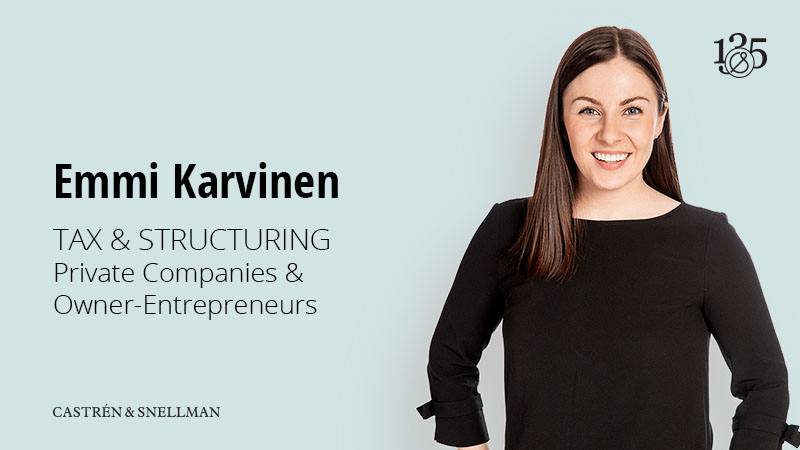
Our Tax & Structuring service was reinforced at the end of March when Senior Associate Emmi Karvinen returned to Castrén & Snellman after working elsewhere for a few years.
12.4.2023
Emmi Karvinen, expert in owner-entrepreneur taxation, to develop a service package for family businesses
Related services
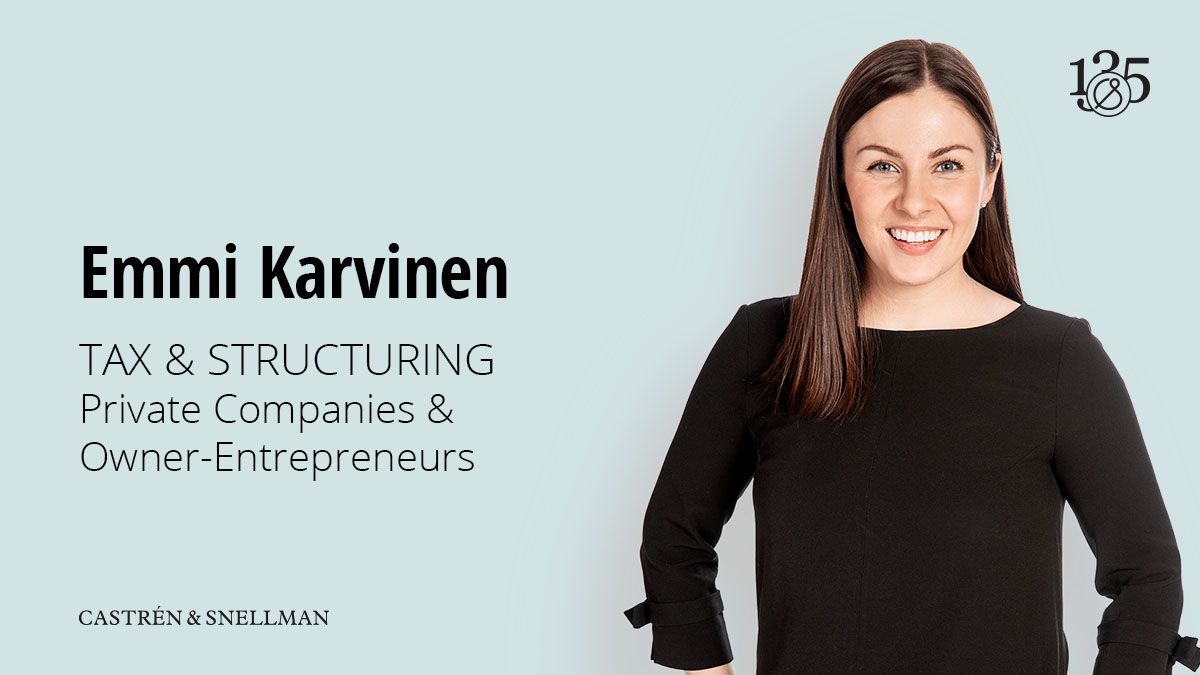
With a versatile career in tax law and a focus on family-owned businesses, Emmi advises our clients particularly on matters related to taxation and wealth management. Emmi has extensive experience in the taxation of family-owned businesses and owner-entrepreneurs, and she is well-versed in mergers and acquisitions, structuring and carrying out family business successions as well as tax litigation matters.
In her new role, Emmi focuses on tax matters and develops a new service package aimed at family-owned businesses.
‘Emmi is familiar with the day-to-day business of both SMEs and family-owned businesses. As a generalist with knowledge of various legal fields, she is a reliable advisor for our clients and an excellent addition to our already strong team. It’s great to have Emmi back on the team,’ says Partner Mikko Alakare, Head of Tax & Structuring.
Emmi joining the C&S Tax & Structuring practice answers the need to tackle the challenges brought on by the ever changing and increasingly complex regulation of the Finnish business scene. By bringing to the table experts in ownership and entrepreneurship taxation, Castrén & Snellman can provide its clients with a straight-forward and seamless one-stop way to deal with tax issues related to ownership, entrepreneurship and business operations.
After graduating as a Master of Laws from the University of Helsinki, Emmi worked at Castrén & Snellman, among others. Two years ago she became a legal counsel at Fundu, where her responsibilities included providing legal advice on various matters ranging from dispute resolution to risk management.
‘I was very excited to return to Castrén & Snellman! There are a lot of familiar faces, and it is great to work together again and to share the knowledge I gained as an in-house lawyer,’ says Emmi.
Economic adjustments may lead to new regulations
Emmi started in her new role in the midst of parliamentary elections. She anticipates that in the new electoral period, the central government will deal with many questions affecting the operating environment of family businesses.
‘The State is in a difficult economic situation, and we will likely see economic adjustments in one form or another. Before the election, the Ministry of Finance published its own budget cut proposal. The Ministry’s proposals are rather contradictory with the hopes and needs of entrepreneurs – for example, increasing the dividend tax of private companies would weaken the position of the owner-entrepreneurs of SMEs,’ Emmi states.
Many unresolved questions remain as the government negotiations get underway.
‘Companies are carefully monitoring the changes proposed by the new Government, as these changes could radically affect their operating environment,’ says Emmi.
Regulation in need of simplification and predictability
Regulatory matters related to company succession are particularly important to family-owned businesses in light of business continuity and predictability. Regulation has increased over time, and entrepreneurs consider the system to be overly complicated.
‘The jungle of regulations has become increasingly dense in recent years: regulation has increased and it is increasingly complex in nature. This is already affecting succession of family businesses and the related tax matters.’
The complex and ever-changing operating environment weakens the businesses’ ability to operate and may hinder expansion into international markets, for example. In her work, Emmi has witnessed the increasing need for legal advice when businesses try to solve legal issues. In her view, it is key that the predictability of taxation does not suffer in a way that would make it more difficult for companies and their owners to plan for the future.
‘It would be important to look at the regulatory environment surrounding privately owned companies and their owners as a whole. The day-to-day business of companies has changed immensely in only a few years, and it is important to consider different ways to support Finnish businesses. What has worked before might not work anymore,’ says Emmi.

Latest news
Latest references

Banyan Software – Acquisition of Carus Ferry
We acted as legal adviser to Banyan Software on its acquisition of Carus Ferry, a Finland-based provider of reservation, check-in and port operations software for ferry and passenger shipping operators. The acquisition further strengthens Banyan Software’s presence in the Nordic region while providing Carus with a long-term partner to support its continued growth and development. Carus was founded in 1998 and is headquartered in Mariehamn on the Åland Islands, Finland. The company develops mission-critical software for ferry, cruise and passenger shipping operators, covering the full passenger journey from booking and ticketing to capacity management, check-in and boarding. Carus also provides port automation, onboard sales systems and business information tools. The company serves approximately 30 operators across four continents and is the largest vendor by customer count in ferry reservation and departure control. Banyan Software is an acquirer and long-term operator of mission-critical software businesses serving specialised industries. Founded in 2016, Banyan follows a buy-and-hold-for-life approach and supports the long-term growth and development of its portfolio companies. Banyan operates more than 130 portfolio companies across North and South America, the United Kingdom, Europe and APAC. Following the acquisition of Carus, Banyan operates three businesses in the Nordic region.
Case published 20.10.2026

Move Energy – Combination of 3North Partners and Steady Energy and related private placement and IPO
We advised Move Energy as an investor in connection with the combination of 3North Partners Plc and Steady Energy Oy and the related private placement and initial public offering of the combined company on Nasdaq First North Growth Market Finland. In connection with the transaction, 3North Partners received approximately EUR 69.8 million in investor commitments from a group of institutional and other investors, including Move Energy, to fund the combined company. Steady Energy is a Finnish nuclear technology company developing a new generation of small modular reactors (SMRs) particularly suited for district heating. Its LDR-50 reactor is designed to provide cities and utilities with a scalable and low-carbon alternative to combustion-based heat production.
Case published 19.10.2026

Efima – Sale of AI business
We advised Efima Oyj on the sale of its AI business to Better Care Technologies Oy. The transaction included Efima’s Moiva AI platform developed for the care sector, the related technology and brand, customer contracts, and the experts working in the business. Efima is a Finnish digital company that supports the sustainable growth of large and mid-sized companies by streamlining their business processes and by creating competitive advantage through the innovative use of artificial intelligence and data. The company has nearly 200 experts based in Helsinki and Tampere.
Case published 21.9.2026

Neoen – Sale of data centre
We advised Neoen Renewables Finland Oy, part of the French Neoen Group, in its sale of a data centre project to a consortium consisting of international data centre developers and operators. This marked Neoen’s first data centre development project in Finland. Founded in 2008, Neoen is one of the world’s leading independent renewable energy producers. The company operates in 15 countries. It develops, finances, builds, owns, and operates solar power plants, wind farms, and battery storage systems. Neoen Group is owned by global alternative asset manager Brookfield Corporation.
Case published 17.9.2026