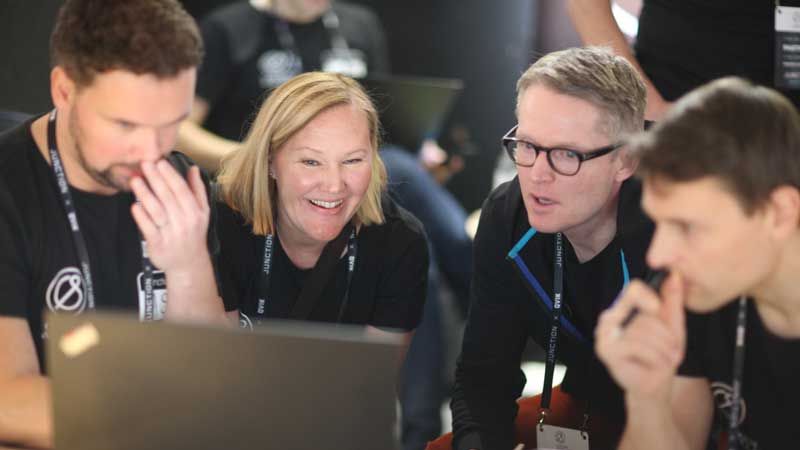
We participated in the Junction 2017 hackathon in November. Our goal was to find people to help us reinvent how clients interact with law firms. We were amazed at the solutions that our twelve international teams presented and are excited to start validating the ideas with our clients.
7.12.2017
Reinventing Interaction With Business Law Firms
The Best Client Experience – Digitised
Legal advisory will always be the core value of business law services, but the way services are delivered will change. To meet client expectations in a new digital world, we have to actively explore the opportunities technology is providing.
Setting Up The Challenge
We wanted the participants of our Legal Tech track and challenge ‘Accessing the Law’ to help us reinvent how clients interact with law firms and access the law. We provided the hackers with three examples of areas they could focus on to ensure an interesting hack.
In the first area, we asked the hackers to find a solution for both clients and lawyers to track the progress of a project. In the second area, we encouraged the hackers to create a solution that provides a price estimate for a project. The third possible area to focus on was to create a solution to gather the information needed to run a legal project successfully. In addition to these three areas, we encouraged the hackers to be brave and think outside the box to improve our client experience.
The Clients’ Journey
As we were preparing for Junction, it became clear that defining and communicating the scope of the challenge was no easy task. We wanted the guidelines to help the hackers get onto the right track, but not stifle them or discourage them from bringing new ideas to the table.
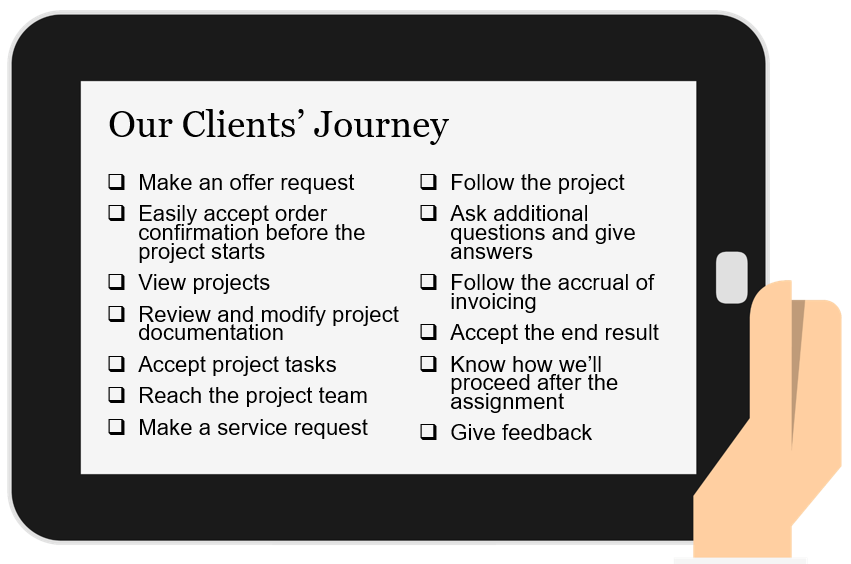
Given that our hackers were not necessarily familiar with the legal field, we decided to provide few examples of typical client interactions that take place during a legal assignment. We used the picture below to communicate our challenge to the hackers. We felt that any one of these examples could benefit from a hack and were happy to see our hackers tackle many of them.
Experiencing Groundbreaking Innovation
As a first timer at a Hackathon, we didn’t know what to expect. It felt as if we were taking a leap into the unknown, which is always exciting. On the flip side, we weren’t sure what the hackers would think of our challenge.
At first, it seemed as if they weren’t very interested in our track. Luckily, this turned out not to be the case—quite the opposite actually. Our track was fully booked with over 40 participants.
It was amazing to watch the teams work and admire how they radiated energy and innovativeness. It is difficult to describe the atmosphere at the venue over the weekend. Everyone should have a chance to experience something similar.
The thing that impressed us the most during these two days were the people—their motivation and talent. None of us had experienced this kind of innovation event before.
Teamwork
Junction was concrete proof of the power of teamwork. In this case, this applied not only to the competing teams, but to us as well. We brought a team of our own people and people from our business partners Talent Base, CSI Helsinki, Arc Technology and Taival to support the participants and give them the best shot to succeed in our challenge.
We were so happy to see the seamless collaboration between lawyers, business service experts and our business partners’ experts. Everyone’s expertise was put to good use over the weekend, and we also received excellent feedback both from the teams and Junction’s organisers.
And The Winner Is?
The demos started with a demo expo in which every team had the opportunity to present their project to a larger audience and get feedback to encourage them to develop their ideas further.
Every track chose their own judges who picked the winners of the track. The Legal Tech track judge team consisted of Pia Ek and Heikki Ilvessalo from our firm as well as Asko Relas (Talent Base) and Reko Lehti (Taival). The judges went from table to table to listen to each team. Each team had to demo their project in a maximum of four minutes, after which the judges had two minutes for questions.

Photo: Juha Nurmela
We have to admit that it was very hard to choose the winner from the twelve amazing solutions presented to us.
In the end, we chose the team ‘Discover’ as the winner of the Legal Tech track. The team’s solution redefined interaction between lawyer and client in a unique way. The goal of the solution is to connect lawyers and clients using an intuitive and forward-thinking interface, including document management, time management and project budgeting, where transparency is of utmost importance.
The tied second best teams ‘Legal Timer’ and ‘Lexio’ chose to create a solution for price estimates. Legal Timer’s solution uses machine learning to analyse the data from our ERP system to create a quick price estimate in place of time-consuming manual assessment. The solution uses intuitive visualisation, is easy to use and can be integrated into our existing CRM system. Lexio’s solution provides a price estimate of the probable cost of an assignment. The service also uses ERP data to provide insight on how much the client can expect to spend according to the total costs of similar cases. Lexio’s solution gives the lawyer a starting point for pricing the case and provides an easy to use interface to send the estimate to the client.
We look forward to having interesting follow-up discussions with the winning teams. You can explore all the solutions from here.
Designing the Best Client Experience
We have already started to discuss the results of Junction with our experts and clients to identify the value of the new ideas in terms of improved client experience.
As our client or business partner, we would like to invite you to help us focus our development initiatives. Feel free to contact us for further information on the Junction challenge and the lessons we learned from it or contact your favorite lawyer to start a dialogue on how we can improve our client experience.
Latest insights
Article published 1.10.2026 – Financial Regulation
New EU-driven banking M&A rules entered into force in Finland on 1 October 2026
 Article published 24.9.2026 – Environment, Energy & Green Transition
Electricity Market Act: Proposed priority procedure to significantly change new electricity network connections in situations of scarce capacity
Article published 24.9.2026 – Environment, Energy & Green Transition
Electricity Market Act: Proposed priority procedure to significantly change new electricity network connections in situations of scarce capacity




 Article published 11.9.2026
Finland proposes a new data centre register – draft legislation open for comments
Article published 11.9.2026
Finland proposes a new data centre register – draft legislation open for comments



 Article published 1.9.2026 – Intellectual Property
New marketing and consumer protection requirements call for action
Article published 1.9.2026 – Intellectual Property
New marketing and consumer protection requirements call for action

Hannu Huotilainen
Marius af Schultén, Kanerva Sunila, Samuli Tarkiainen, Jonas Holm & Noora Ahonen
Marius af Schultén, Antti Kaakkola, Samuli Tarkiainen, Mikko Alakare, Janne Juusela & Jerker Pitkänen
Hilma-Karoliina Rozell
Latest references

Banyan Software – Acquisition of Carus Ferry
We acted as legal adviser to Banyan Software on its acquisition of Carus Ferry, a Finland-based provider of reservation, check-in and port operations software for ferry and passenger shipping operators. The acquisition further strengthens Banyan Software’s presence in the Nordic region while providing Carus with a long-term partner to support its continued growth and development. Carus was founded in 1998 and is headquartered in Mariehamn on the Åland Islands, Finland. The company develops mission-critical software for ferry, cruise and passenger shipping operators, covering the full passenger journey from booking and ticketing to capacity management, check-in and boarding. Carus also provides port automation, onboard sales systems and business information tools. The company serves approximately 30 operators across four continents and is the largest vendor by customer count in ferry reservation and departure control. Banyan Software is an acquirer and long-term operator of mission-critical software businesses serving specialised industries. Founded in 2016, Banyan follows a buy-and-hold-for-life approach and supports the long-term growth and development of its portfolio companies. Banyan operates more than 130 portfolio companies across North and South America, the United Kingdom, Europe and APAC. Following the acquisition of Carus, Banyan operates three businesses in the Nordic region.
Case published 20.10.2026

Move Energy – Combination of 3North Partners and Steady Energy and related private placement and IPO
We advised Move Energy as an investor in connection with the combination of 3North Partners Plc and Steady Energy Oy and the related private placement and initial public offering of the combined company on Nasdaq First North Growth Market Finland. In connection with the transaction, 3North Partners received approximately EUR 69.8 million in investor commitments from a group of institutional and other investors, including Move Energy, to fund the combined company. Steady Energy is a Finnish nuclear technology company developing a new generation of small modular reactors (SMRs) particularly suited for district heating. Its LDR-50 reactor is designed to provide cities and utilities with a scalable and low-carbon alternative to combustion-based heat production.
Case published 19.10.2026

Efima – Sale of AI business
We advised Efima Oyj on the sale of its AI business to Better Care Technologies Oy. The transaction included Efima’s Moiva AI platform developed for the care sector, the related technology and brand, customer contracts, and the experts working in the business. Efima is a Finnish digital company that supports the sustainable growth of large and mid-sized companies by streamlining their business processes and by creating competitive advantage through the innovative use of artificial intelligence and data. The company has nearly 200 experts based in Helsinki and Tampere.
Case published 21.9.2026

Neoen – Sale of data centre
We advised Neoen Renewables Finland Oy, part of the French Neoen Group, in its sale of a data centre project to a consortium consisting of international data centre developers and operators. This marked Neoen’s first data centre development project in Finland. Founded in 2008, Neoen is one of the world’s leading independent renewable energy producers. The company operates in 15 countries. It develops, finances, builds, owns, and operates solar power plants, wind farms, and battery storage systems. Neoen Group is owned by global alternative asset manager Brookfield Corporation.
Case published 17.9.2026