Your phone rings at 9:04 AM on a Tuesday morning. Inspectors from the Competition and Consumer Authority (the FCCA) have arrived at your company’s lobby to perform an unannounced inspection, ie. a “dawn raid”.
18.12.2015
How to survive an unannounced inspection ‘dawn raid’ of the competition authorities?


Kiti Karvinen
Related services
The competition authorities do not announce their inspections beforehand. Inspections typically take place early in the morning and usually in the beginning of the week. In addition to company’s premises, dawn raids may be conducted in other premises as well, such as employee’s home or summer cottage.
You wonder what it’s all about. The FCCA’s inspectors tell you that they have the power to conduct inspections at whichever company to investigate whether competition rules have been breached. An inspection may derive from a complaint or anonymous tip-off made by e.g. your customer or competitor.
What happens during an inspection?
You ask the inspectors to wait for your attorney who will arrive in an hour. The inspectors however refuse to wait and announce that they will start the inspection immediately.
You let them proceed, because you remember from your compliance training that merely stalling or obstructing an inspection may result in fines. You guide the inspectors to a meeting room.
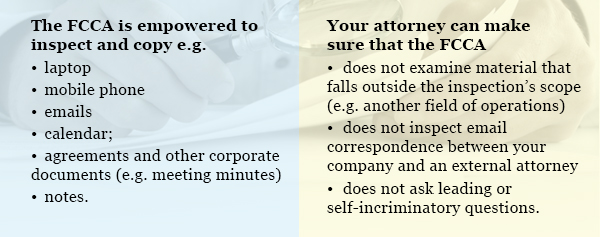
Next the inspectors ask you to contact the persons whose offices and computers they wish to inspect. The FCCA has very broad powers to inspect personnel’s offices as well as documents and devices found in the offices. However, the inspectors are not allowed to inspect correspondence between a company and its attorney. Your attorney is there to make sure that the FCCA does not inspect such documents.
May the FCCA seal premises?
The FCCA does not manage to bring the inspection to an end during that day. Therefore, they inform you that the inspection will continue the next morning. At the end of the day the inspectors seal the offices and remind you that the seals may not be broken in any circumstances.
You arrive at work early next morning to find out that the seal on the CEO’s door has been broken. You suspect that the cleaner has not noticed the warning sign and has mistakenly broken the seal.
You explain the situation to the inspectors when they arrive. However, the inspectors tell you they’ve heard the same story before and your company will be fined for breaking the seal.
What may the FCCA ask during an interview?
During the second day the inspectors want to interview you. During the interview they ask you which competitors you have met and when. You discuss the matter openly with them.
Thereafter, the inspectors ask you details about a certain meeting. As you cannot recall everything, you reply vaguely. The inspectors are not satisfied with your response and ask you whether you and your competitor agreed on prices during the meeting. This is where your attorneys jumps in and tells the inspectors that they are not allowed to ask such questions.
How does the investigation continue?
After the on-site inspection, the FCCA will go through the material copied before reverting to your company. In practice, this means that the FCCA may request further information and finally either close the investigation or make a fine proposal to the Market Court.
Although the FCCA’s inspection may be unfounded, you have to make sure your company’s compliance guide is up-to-date and the personnel is familiar with competition rules.
Checklist for inspection:

Latest insights
Article published 26.10.2026 – FDI Regulatory Service
Reform of Finnish FDI screening moves forward: significant changes and broader scope

 Article published 30.3.2026 – Competition & Procurement
Finnish FDI screening under reform — Update following the stakeholder consultation
Article published 2.12.2025 – Competition & Procurement
Sustainable Procurement: Legislative requirements and practical challenges
Article published 30.3.2026 – Competition & Procurement
Finnish FDI screening under reform — Update following the stakeholder consultation
Article published 2.12.2025 – Competition & Procurement
Sustainable Procurement: Legislative requirements and practical challenges

 Article published 27.3.2024 – Corporate Crime & Internal Investigations
The best tender won – or did it?
Article published 27.3.2024 – Corporate Crime & Internal Investigations
The best tender won – or did it?

Kiti Karvinen, Joachim Wik & Johanna Kyllöinen
Kiti Karvinen, Johanna Kyllöinen & Joachim Wik
Laura Vuorinen & Johanna Lähde
Johanna Lähde & Eveliina Tammela
Latest references

HANZA – Acquisition of Fortaco Finland’s heavy mechanics and assembly business
We are acting as Finnish legal advisor to HANZA in connection with its acquisition of Fortaco Finland’s heavy mechanics and assembly business. The transaction is structured as a combined asset and share acquisition and includes Fortaco Finland’s heavy mechanics and assembly operations in Finland, as well as shares in two Estonian and two Polish subsidiaries. The transaction is expected to close during the fourth quarter of 2026, subject to customary closing conditions, including regulatory approvals. Founded in 2008, HANZA is a Swedish mechanical engineering and electronics contract manufacturing company listed on the Nasdaq Stockholm main list. HANZA has approximately 5,000 employees and annual sales of SEK 10 billion. We advise HANZA on this transaction in collaboration with the Swedish law firm Lindahl.
Case published 15.7.2026

Shareholders – Sale of the Suomen Autohuolto Group
We advised the shareholders of Suomen Autohuolto Oy in connection with the sale of the company’s entire share capital, to SAKA Finland Group Oy. Suomen Autohuolto Group is one of Finland’s largest companies specializing in brand-specific automotive maintenance and has locations in Oulu, Tampere, and from July, also in Järvenpää. The transaction is subject to final approval by the Finnish Competition and Consumer Authority (KKV).
Case published 26.6.2026

G&W Electric – Acquisition of Safegrid
We advised G&W Electric with its acquisition of Safegrid Oy, a leading provider of intelligent grid monitoring solutions based in Finland. The acquisition accelerates G&W Electric’s long-term strategy to integrate intelligent monitoring and predictive analytics into its power distribution portfolio, strengthening its offering to utility customers worldwide. Founded in 1905 and headquartered in Bolingbrook, Illinois, G&W Electric is a global leader in innovative power grid solutions, with a presence in over 100 countries. The company is known for advanced load and fault interrupting switches, reclosers, sensors, system protection equipment, power grid automation, intelligent grid monitoring, and transmission and distribution cable accessories. Safegrid is a Finnish technology company headquartered in Espoo, Finland. The company develops the Intelligent Grid System®, a grid monitoring solution that combines instant-on wireless sensors with advanced analytics to deliver real-time insight into grid conditions, enabling utilities to identify emerging issues, anticipate failures, and reduce outage duration across medium and high voltage distribution and transmission networks.
Case published 8.5.2026

Taaleri – Acquisition of a majority stake in Nordic Science Investments
We are acting as legal adviser to Taaleri Plc on its acquisition of a 51 per cent ownership stake in Nordic Science Investments Oy (NSI), marking Taaleri’s expansion into deeptech-driven venture capital. Through the transaction, Taaleri broadens its private equity offering into early-stage venture capital funds as well as the commercialisation and scaling of research-driven innovations. NSI is a Finnish venture capital fund manager operating across the Nordic and Baltic regions, focusing on early-stage investments in research- and science-based technologies. Its portfolio companies develop, among other things, health technologies, life sciences, advanced materials and AI-driven solutions. In addition to providing growth capital, NSI supports spin-out companies with strategic guidance, access to networks and assistance in building teams during the early phases of business development. NSI’s first fund, the EUR 45 million NSI Nordic Science I Ky, was established in 2024 and has to date invested in 22 early-stage companies in Finland, Sweden and the Baltic countries. Taaleri is a specialist in investments, private asset management and non-life insurance, with a strong position in renewable energy, bioindustry and housing investments as well as credit risk insurance. Taaleri has EUR 2.7 billion of assets under management in its private equity funds, co-investments and single-asset vehicles, employs approximately 130 people and is listed on Nasdaq Helsinki. The founders of NSI will continue in their operational roles following the transaction. The completion of the transaction is subject to approval by the FIN-FSA.
Case published 13.4.2026