Antti Kaakkola, who heads Castrén & Snellman’s Real Estate Investments & Transactions service, became a partner at the firm at just thirty-three. He has played a part in major assignments from a young age.
11.5.2021
Career Stories: Antti Kaakkola
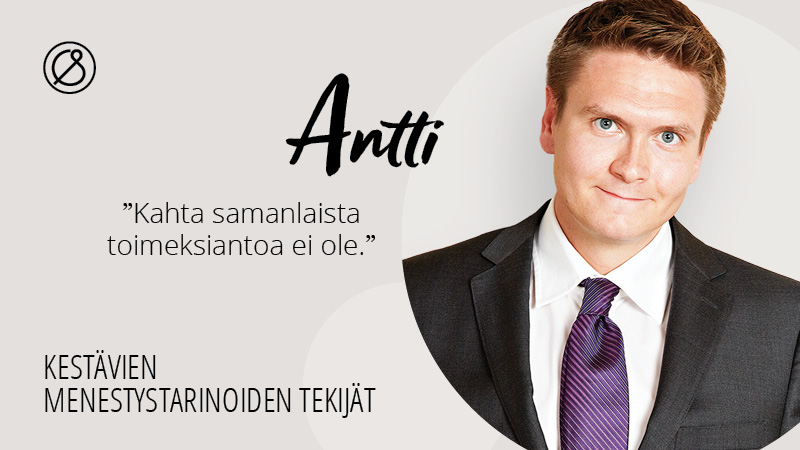

Antti Kaakkola
For example, Antti and his team handled the sale-and-lease-back of OP Financial Group’s headquarters and advised the investors in the Mall of Tripla, REDI shopping centre and Tampere Central Deck and Arena projects.
‘These have been interesting projects that have kept our team busy over an extended period. I love being a part of important projects with major clients.’
How did Antti make partner and land major assignments in his early thirties? Antti sees two main reasons for his rapid career development.
‘First of all, I have to be humble, as I found myself in the right place at the right time. I was able to play a key role in the kinds of assignments that were in high demand’, Antti says.
‘Of course, you also need the right attitude and skillset for the job. This is a customer service profession. You have to understand the client’s goals and do your best to help the client achieve them’, Antti continues.
C&S Career Began as a Trainee
In high school, Antti was considering whether he wanted to study either law or economics. He ended up choosing law school at the University of Helsinki, because he thought it would give him more options for work after graduation. His father’s interesting stories about working as a lawyer also played a role in his decision.
Antti joined Castrén & Snellman towards the end of this studies in 2011. He worked first as a senior trainee and later as a project trainee while writing his thesis. After that he was invited to continue in the firm as an associate.
‘At that point, I hadn’t given much thought to whether I wanted to stay in a large law firm, but once I was offered a position in Finland’s number one firm, I decided to seize the opportunity.’
Castrén & Snellman was already involved in extensive real estate deals at the time and needed extra hands. This was how Antti began specialising in real estate transactions.
Three Reasons to Become a Real Estate Lawyer
When law students are asked what they want to do after graduation, few mention real estate transactions. Nevertheless, Antti recommends at least considering it as a specialisation.
‘Real estate law is much more interesting than you might at first think’, he says and lists three good reasons to work in the field:
‘One. Even though the deals revolve around real estate, the work itself revolves around people. Real estate investors and developers and the people working in construction companies are a great group of people that is fun to work with.
Two. Real estate transactions are a field that a single person can get a comprehensive handle on if they have the motivation. No two assignments are the same, but the basic framework is easy enough to master.
Three. Real estate is a significant market. Specialising in it opens a lot of doors for a lawyer. Real estate experts are in high demand.’

Latest news
Latest references

Banyan Software – Acquisition of Carus Ferry
We acted as legal adviser to Banyan Software on its acquisition of Carus Ferry, a Finland-based provider of reservation, check-in and port operations software for ferry and passenger shipping operators. The acquisition further strengthens Banyan Software’s presence in the Nordic region while providing Carus with a long-term partner to support its continued growth and development. Carus was founded in 1998 and is headquartered in Mariehamn on the Åland Islands, Finland. The company develops mission-critical software for ferry, cruise and passenger shipping operators, covering the full passenger journey from booking and ticketing to capacity management, check-in and boarding. Carus also provides port automation, onboard sales systems and business information tools. The company serves approximately 30 operators across four continents and is the largest vendor by customer count in ferry reservation and departure control. Banyan Software is an acquirer and long-term operator of mission-critical software businesses serving specialised industries. Founded in 2016, Banyan follows a buy-and-hold-for-life approach and supports the long-term growth and development of its portfolio companies. Banyan operates more than 130 portfolio companies across North and South America, the United Kingdom, Europe and APAC. Following the acquisition of Carus, Banyan operates three businesses in the Nordic region.
Case published 20.10.2026

Move Energy – Combination of 3North Partners and Steady Energy and related private placement and IPO
We advised Move Energy as an investor in connection with the combination of 3North Partners Plc and Steady Energy Oy and the related private placement and initial public offering of the combined company on Nasdaq First North Growth Market Finland. In connection with the transaction, 3North Partners received approximately EUR 69.8 million in investor commitments from a group of institutional and other investors, including Move Energy, to fund the combined company. Steady Energy is a Finnish nuclear technology company developing a new generation of small modular reactors (SMRs) particularly suited for district heating. Its LDR-50 reactor is designed to provide cities and utilities with a scalable and low-carbon alternative to combustion-based heat production.
Case published 19.10.2026

Efima – Sale of AI business
We advised Efima Oyj on the sale of its AI business to Better Care Technologies Oy. The transaction included Efima’s Moiva AI platform developed for the care sector, the related technology and brand, customer contracts, and the experts working in the business. Efima is a Finnish digital company that supports the sustainable growth of large and mid-sized companies by streamlining their business processes and by creating competitive advantage through the innovative use of artificial intelligence and data. The company has nearly 200 experts based in Helsinki and Tampere.
Case published 21.9.2026

Neoen – Sale of data centre
We advised Neoen Renewables Finland Oy, part of the French Neoen Group, in its sale of a data centre project to a consortium consisting of international data centre developers and operators. This marked Neoen’s first data centre development project in Finland. Founded in 2008, Neoen is one of the world’s leading independent renewable energy producers. The company operates in 15 countries. It develops, finances, builds, owns, and operates solar power plants, wind farms, and battery storage systems. Neoen Group is owned by global alternative asset manager Brookfield Corporation.
Case published 17.9.2026