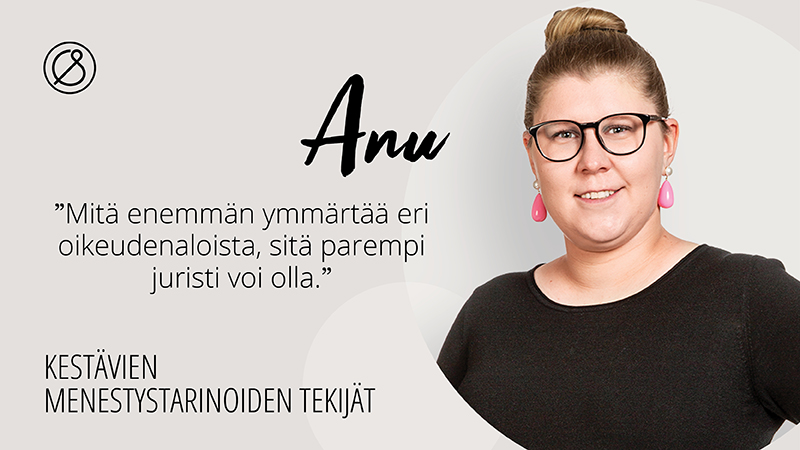
Anu Sillanmäki is a newly appointed member of the Finnish Bar Association and a senior associate at Castrén & Snellman. She encourages her colleagues to go on secondment.
In law firms, a secondment means temporarily working either in another team or in a client company. Anu has done both. Last spring, she was on secondment with Metsä Group for three months.
‘It was an all-around great experience. I learned a lot being able to see the work law firms do from the perspective of the client. It’s worth a try if the opportunity arises.’
Over the spring, Anu worked with many different business units and a wide variety of fields of law. Some of her assignments were very similar to her work at C&S, such as commenting on agreements, but many of them were entirely new to her. Thanks to her secondment, Anu learned what it’s like to work as an in-house lawyer.
Anu works in Castrén & Snellman’s International Construction & Projects team. She advises the firm’s clients in international and domestic project and energy law assignments and in real estate transactions. Typical tasks for her include drafting and commenting on agreements and, in particular, taking part in energy sector transactions.
A Lawyer by Chance
Anu became a lawyer by chance. As a child, Anu moved with her family to England, and Anu attended lower and upper secondary school in English.
‘I liked the English language and went to study English in the Faculty of Arts. During my studies, I realised that while I enjoyed both the language and my studies, I didn’t necessarily want to make a career out of it.’
Anu found a new field thanks to her boyfriend. When her boyfriend, now her husband, decided to switch fields and applied to law school, Anu decided to follow the next year.
‘Being fluent in English has been very useful working at a law firm, as most of our documents are drafted in English.’
A Career U-Turn
Anu was smitten by competition law in her very first year of law school. She took every optional course available on competition law and wrote her seminar papers and master’s thesis on it, as well. Before graduating and for a few months afterwards as well, she worked at the Finnish Competition and Consumer Authority in competition enforcement.
‘Throughout my studies, I was certain I would become a civil servant and that law firms were not for me. As graduation grew closer, however, I thought I should at give working in a law firm a try.’
The direction of her career changed when she got a job in the competition law team at a large law firm.
‘First of all, I found that I actually enjoyed working in a law firm. Second, I was exposed to other fields of law through working with other teams at the firm and realised that competition law was not the only field that interested me. I realised that university courses provide a fairly narrow and theoretical picture of different fields of law.’
Experience in Many Fields of Law
Many young lawyers are eager to find ‘their thing’ as soon as possible. However, Anu would encourage them to try out many different fields of law.
‘Many law students think that it’s important to find their favourite field of law during their studies and that their first job after graduation will determine the rest of their career. I think it’s worth collecting a wide range of experience. The more you know about different fields of law, the better lawyer you will be, because most cases touch on multiple fields.’
One of the things that Anu particularly likes about Castrén & Snellman is that the firm has a wide service offering.
‘Many of the assignments we have involve different fields of law and require collaboration between different teams. We also have the opportunity to work in other teams according to our interests and workload. It adds a lot of variety to work and is one of the things I like most about C&S. Everyone at the firm has a secondary team, which lowers the threshold to try out other fields.’
A Once in a Lifetime Christmas Gift
Anu got a unique gift last Christmas, as she was accepted into the Finnish Bar Association on 24 December 2020.
‘It was a very nice Christmas gift’, she laughs.
Anu will continue learning and getting to know new fields of law, as she is starting court training in May. Her court training will be half with the Eastern Uusimaa District Court and half with the Helsinki Administrative Court.
Anu is looking forward to challenging herself, deepening her general knowledge of the law and maybe kindling a spark for dispute resolution.
‘I’ve heard that court training can give you a lot of confidence. I’m sure that jumping into a new challenge and having to solve entirely different kinds of legal problems than the ones I’m used to will do just that for me, as well.’
Latest news
Latest references

Fortum – AI workshop
We delivered two AI workshops for Fortum Corporation’s Mergers and Acquisitions team, with both legal and business professionals participating. The sessions combined fundamental AI principles with custom use cases for commercially available AI tools tailored to Fortum’s needs. We also presented a bespoke solution merging AI with a script-based tool developed by our Legal Tech team, enabling a more automated way of working. Our experts conducted the training drawing on their legal background and leading experience in this emerging field of legal technology. Participants particularly appreciated the clarity and relevance of the implementations demonstrated. ‘C&S delivered an excellent, well-structured series of workshops, with directly applicable takeaways,’ says Sabina Hautaviita, Legal Counsel for M&A at Fortum.
Case published 9.3.2026

VR – Supreme Court decision clarifies working time practices
We successfully represented VR Group before the Supreme Court in a case concerning the meal break practice of commuter train drivers. On 6 February 2026, the Supreme Court ruled in VR’s favour (decision KKO:2026:12), confirming that VR had the right to amend the commuter train drivers’ meal break practice in 2021 by rendering the break unpaid in accordance with the applicable collective agreement. This decision clarifies the interpretation of collective agreements and employment legislation as well as the limits of the employer’s right to direct work. Over 250 commuter train drivers challenged the unpaid meal break practice which VR introduced in April 2021. Before the change, meal breaks had a long history of being paid. The change was based on the train drivers’ collective agreement, which allows for meal breaks to be organised either as paid or unpaid time. The Supreme Court ruled that the scheduling and managing of breaks falls within the core area of the employer’s right to direct work. This increases the threshold for an established practice becoming a binding condition for the parties. Merely following a practice consistently and over a long period of time does not make the practice binding; instead, the employer’s intent to commit to the practice must be clearly evident from the employer’s conduct or other circumstances. As both alternatives – paid and unpaid – for organising meal breaks had been retained in the collective agreement despite other amendments over the years, it could not be considered that VR had intended to commit to the paid break practice and waive its right to direct work as regards break scheduling. It was also significant that the employment contracts explicitly referred only to the collective agreement as regards working time. The Supreme Court deemed that the employees’ paid meal break was not an established term of employment and that VR was entitled to change the practice based on the collective agreement. The employer had the right, by virtue of its right to direct work, to unilaterally change the meal break practice by choosing to apply the other arrangement permitted by the collective agreement.
Case published 3.3.2026

CapMan Growth – Investment in Kuntokeskus Liikku
We are assisting CapMan Growth in its significant investment in Kuntokeskus Liikku, a Finnish gym chain known for its high-quality self-service facilities and excellent value for money. The investment will further strengthen Liikku’s position as a market leader and support the continued execution of its growth strategy. Liikku is one of Finland’s leading fitness chains, with more than 70 locations across the country serving nearly 90,000 members. The company’s concept is to offer high-quality self-service gyms at an exceptionally competitive price point which, combined with strong operational efficiency, provides a solid foundation for profitable growth. The company’s main shareholder is COR Group, a long-time partner of CapMan Growth, and a Finnish health and wellness conglomerate known for active ownership and long-term value creation. CapMan Growth is a leading Finnish growth investor that makes significant investments in entrepreneur-led growth companies with a turnover of €10–200 million. CapMan Growth is part of CapMan, which is a leading Nordic private equity investor engaged in active value creation work. CapMan has been listed on the Helsinki Stock Exchange since 2001.
Case published 27.2.2026

Terrafame – Environmental and water management permit processes concerning the company’s entire operations and the KL1 side rock area
Castrén & Snellman successfully assisted Terrafame Ltd in environmental and water management permit processes concerning the company’s entire operations and the KL1 side rock area, on which the Supreme Administrative Court issued its decision on 12 February 2026 (KHO 366/2026 and 367/2026). The changes made to the decisions of the Vaasa Administrative Court as a result of Terrafame’s appeals, enable the company to implement its new strategy and develop its operations as planned. The decisions of the Supreme Administrative Court brought the nearly ten-year-long permit process to a close.
Case published 20.2.2026